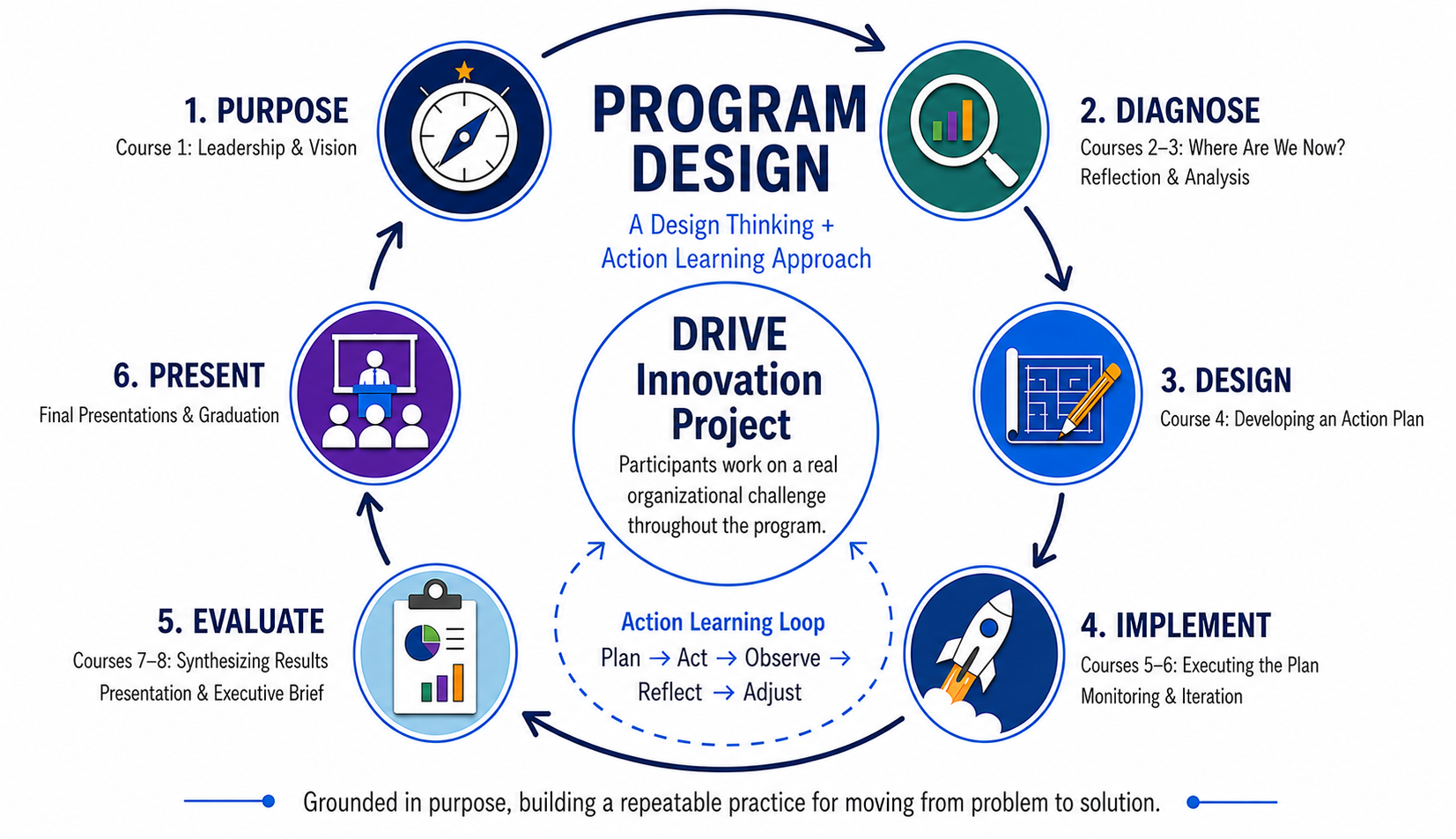
Every course in DRIVE is a chapter in a single continuous story. Click any course to expand its focus, core concepts, and DRIVE Innovation Project contribution.
Upon successful completion of the program, participants will be able to:
Each course pill below represents one chapter of the program arc. Click to expand the full course focus, core concepts, and DRIVE Innovation Project deliverable.
This foundational course grounds participants in the core of transformational leadership: understanding and articulating "the why." Participants explore the psychology and sociology of organizational change, the critical role of leadership in inspiring belief, and how to assess an organization's readiness for transformation from a human and cultural perspective. Personal purpose is connected to organizational mission, laying the essential groundwork for the DRIVE Innovation Project.
Organizational purpose and identity; psychology and sociology of organizational change; leadership theories for inspiring transformation; human dynamics of resistance and commitment; internal change readiness assessments; problem statement formulation rooted in organizational purpose.
Participants identify a real-world organizational challenge that will serve as their DRIVE Innovation Project throughout the program. They develop a preliminary problem statement articulating the compelling "why" for the initiative, outline the initial scope of their action research, and identify key stakeholders.
Participants are equipped with rigorous tools to diagnose healthcare challenges, learning to integrate qualitative and quantitative data across clinical, operational, cultural, and economic dimensions. The goal is to replace assumptions with insight — creating the foundation for meaningful innovation and positioning leaders to design solutions that respond to organizational truth rather than surface-level symptoms.
Problem identification techniques (5 Whys, fishbone diagrams); problem framing; data collection methods (interviews, surveys, observations); qualitative and quantitative analysis; process mapping; healthcare supply chain diagnostics; organizational culture assessment; external economic analysis of healthcare markets.
Participants rigorously identify and define a specific healthcare problem within their organization and develop a comprehensive data collection plan — identifying key data points, methods, and potential sources including EHR data, patient satisfaction data, cultural indicators, and economic and market data.
Participants critically analyze collected data using strategic frameworks, financial diagnostics, and organizational models to uncover deeper drivers of performance challenges. They reflect on the meaning of findings in the broader context of their organization's mission and evolving healthcare demands, synthesizing insights that will guide solution development in the next phase of the DRIVE Innovation Project.
Data interpretation; root cause analysis; strategic analysis; financial statement analysis; trend identification; basic financial diagnostics and interpretation.
Participants analyze the data collected for their DRIVE Innovation Project, identifying key findings, root causes, and potential strategic opportunities. They present an "Analysis of Findings" brief, including financial implications.
Participants design and make actionable change strategies — moving from ideas on paper to concrete prototypes and pilot-ready concepts — while setting clear goals and crafting communication plans that engage diverse stakeholders. They evaluate the strategic fit, operational implications, and financial viability of proposed interventions, ensuring what they design is not only innovative but buildable, testable, and realistic in their healthcare context.
Strategic alignment for healthcare initiatives; goal setting frameworks; communication strategy for healthcare audiences; stakeholder mapping; business case development for new programs and services; financial forecasting for proposed healthcare strategies.
Participants formulate a strategic plan for their DRIVE Innovation Project, including specific goals, a detailed communication plan, and a preliminary financial projection for proposed measurables and milestones.
Participants develop strategies and tactics for effective implementation, focusing on managing resistance, influencing stakeholders, and working within the real operational and supply chain constraints of healthcare delivery. They learn to experiment thoughtfully with how changes fit into everyday practice, critically assess what already exists, and uncover creative ways to generate greater value from current capabilities — for patients, staff, and the organization as a whole.
Project management for healthcare initiatives; change leadership in clinical settings; resistance management among healthcare professionals; influence tactics in interdisciplinary teams; operational workflow adjustments for new procedures or technologies; healthcare supply chain coordination.
Participants develop a detailed implementation plan including a timeline, resource allocation (medical equipment, staffing plans), and a strategy for addressing potential resistance. They also outline how operational processes or supply chain elements will be impacted.
Participants shift from implementation to disciplined monitoring, data collection, and iteration. They track clearly defined success measures, gather quantitative and qualitative evidence on how their solution is performing in real clinical and operational contexts, and use agreed-upon "pivot permissions" to decide when to adjust course. They examine where value is being created — or not — for patients, staff, and the organization, and make targeted refinements based on what the data reveal.
Performance monitoring for healthcare quality improvement; feedback loops in clinical practice; agile methodologies adapted for healthcare; qualitative data analysis during implementation; adaptive leadership in complex healthcare environments.
Participants propose methods for ongoing monitoring of their DRIVE Innovation Project's implementation, outline how they would collect mid-course data, and propose initial iterative adjustments based on early findings.
Participants integrate diverse data sources to assess the outcomes of their initiatives, identify broader systemic effects, and reflect on the organizational and strategic implications. They practice drawing robust, evidence-based conclusions that reveal both successes and lessons learned, creating a strong foundation for communicating impact and planning future cycles of improvement.
Systems thinking for complex healthcare organizations; causal loop diagrams for healthcare processes; strategic implications for patient outcomes and service delivery; organizational learning in healthcare; advanced data synthesis for clinical and operational results; pattern recognition in health data; holistic impact assessment.
Participants synthesize all data and findings from their DRIVE Innovation Project, draw comprehensive conclusions about its success and challenges, and articulate the broader systemic implications for their organization in a "Synthesized Findings and Systemic Implications" report.
Participants craft professional presentations and concise executive briefs that highlight key findings, strategic insights, and financial implications — while experimenting with alternative formats for executive communication. They tailor their message to different audiences, using data storytelling and persuasive communication to influence decision-making in the C-suite, clinical leadership meetings, and board discussions. This final course consolidates the entire project into a compelling case for action while setting the stage for a new cycle of continuous organizational learning.
Executive communication for healthcare leaders; data storytelling for patient outcomes; persuasive presentation techniques; report writing for healthcare administration; stakeholder engagement in healthcare reform; future scanning for healthcare trends; continuous improvement in patient care processes.
Participants finalize their comprehensive DRIVE Innovation Project report, develop a professional presentation ready for delivery to their leadership team, and write a succinct executive brief summarizing the problem, solution, financial justification, implementation, synthesized results, systemic implications, and recommendations for next steps.